

Outdoor fire restrictions
Outdoor fire rules you need to follow in a Restricted Fire Zone (RFZ) — a specific area where outdoor fires are not permitted in Ontario.
Restricted fire zone
A Restricted Fire Zone (RFZ) is an order made by the ministry, under the Wildland Fire Management Act restricting the use of open fires in a specific area of the province. It is a temporary measure put in place to prevent human-caused fires when the fire hazard is extreme or when firefighting resources are limited.
The law
By law, you cannot have an outdoor fire in a RFZ, except in accordance with a permit or unless specific conditions have been met under the Wildland Fire Management Act and Ontario Regulation 43/26 (Wildland Fire Management). This includes all burning, including grass, debris and campfires, even when using an outdoor fire grate, fireplace or fire pit. Contact your local Fire Management Headquarters for more information.
If your municipality has also imposed a fire ban, you must comply with both the RFZ and the municipal ban.
RFZs are only imposed by the ministry inside the Ontario Fire Region.
Municipal fire bans
Municipal fire bans are imposed by your local municipality.
Inside the fire region, both a municipal fire ban and a ministry RFZ can be in place on the same piece of land at the same time. If both are in place, you must comply with both.
If an RFZ or a municipal ban are lifted, the other ban could remain in place and continue to restrict the use of outdoor fires. It is important to check with your local municipality or local municipal fire department for any municipal fire bans or restrictions on outdoor burning in your area.
Outside the Ontario Fire Region, only municipalities have the authority to restrict outdoor fires through their municipal fire bans. A ministry RFZ would not apply in areas located outside the fire region.
Office of the Fire Marshal fire bans
The Office of the Fire Marshal may also impose their own fire bans in unincorporated territories that are inside the Ontario Fire Region.
This type of fire ban will not be imposed when there is a ministry RFZ in place.
Exceptions
There are exceptions to the use of outdoor fires in a RFZ. If strict criteria are met, campfires and charcoal barbeques may be allowed in organized campgrounds or provincial parks.
Reasons for a RFZ
There are 2 reasons why a RFZ is in effect.
- When outdoor conditions are extremely dry.
- The number of fires occurring has stretched firefighting resources to capacity.
A RFZ is a temporary measure for extreme situations. As soon as outdoor conditions permit, the restrictions are lifted.
Look for RFZ Signs
Look for and obey the RFZ signs. 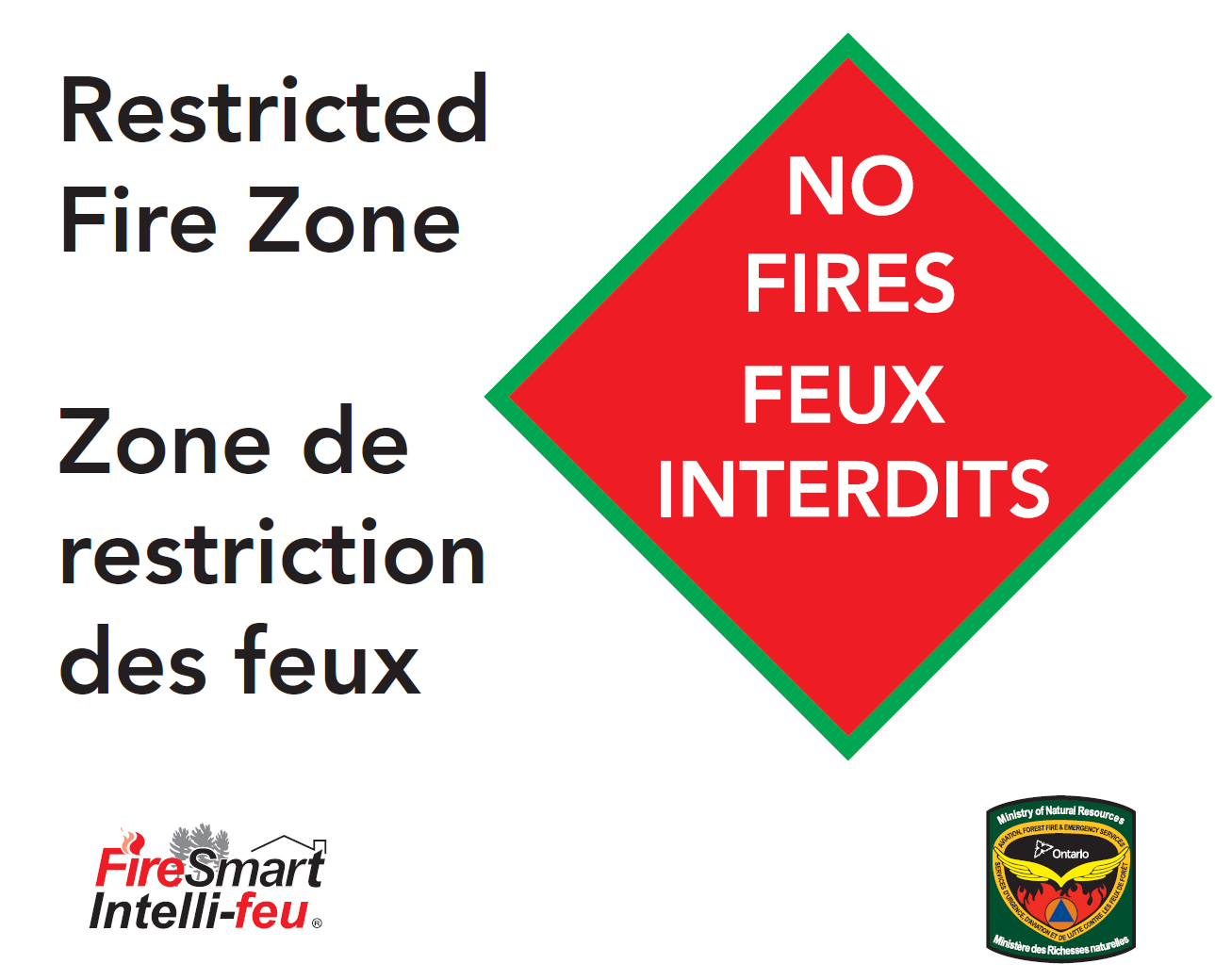
Highly visible green and red RFZ signs are placed:
- along roadways
- at popular camping spots
- in sport lodges
- in gas stations and stores in the affected area
Large advertisements also appear in local newspapers and announcements are made on radio and television stations in the area. These announcements may indicate which areas are restricted by referring to the fire zone number.
RFZ areas
What you cannot use
Except in organized campgrounds and provincial parks, you cannot:
- have campfires (even in an outdoor fire grate, fireplace or fire pit)
- burn grass or woody debris
- use burn barrels
Organized campground operators and provincial parks may allow their guests to continue enjoying campfires during a RFZ period provided certain strict conditions are met under Ontario Regulation 43/26.
What you can use
Gas or fuel stove
If you need heat for cooking or warmth in a RFZ, you can only use:
- a portable liquid fuel or gas stove (for example, barbeque), that can be turned off easily by closing a shut-off valve or lid
- the stove must be at least 1 metre away from any naturally occurring flammable material
Charcoal
You can use a charcoal installation in a RFZ for cooking or warmth, only if you are within 100 metres of a permanent structure used as a dwelling and are on land that you legally occupy.
Your charcoal installation must be:
- at least 1 metre from any naturally occuring flammable material
- designed to use commercially produced charcoal as fuel
- using commercially produced charcoal as fuel
- completely extinguished and all ashes and coals safely disposed of before installation is moved or left unattended
Wood burning stove or furnace
You can use an outdoor wood burning stove or furnace only if you are within 100 metres of a permanent structure used as a dwelling and are on land that you legally occupy.
Your wood burning installation must be:
- at least 5 metres from any wildland area (including grass, brush and forest)
- at least 2 metres from any flammable material
- situated on bare rock, mineral, soil or other material that won’t burn and extends 2 metres around the stove or furnace in all directions
- designed to be used for cooking or warmth
- designed to use wood as the fuel source and wood is being used as the fuel
- made entirely of non-combustible material
- enclosed the fire on all sides with solid material
- equipped with working spark arresting devices for all vents and chimneys
- if the wood burning stove is portable, all ashes and coals produced are completely extinguished and safely disposed of before the stove is moved
Safety tips
To exercise extreme caution when travelling in a RFZ:
- be careful with anything that could start a fire
- watch your propane or gas equipment carefully
- smoke only when you’re stationary, never while walking or working in the bush
- make sure all matches or cigarettes are out before disposing of them
Penalties
Once a RFZ is declared, it is illegal to set a fire for any purpose within the affected area unless specific conditions have been met.
Failure to comply could result in:
- a fine up to $50,000 for an individual or $500,000 for a corporation
- 1 year in jail
- financial responsibility for any costs incurred in fighting a wildland fire or damages arising from the fire
Report a fire in a RFZ
Report a fire in a RFZ (except in a campground or provincial park) to your local ministry work centre.