

Forest fires
Find information about the current danger, activity and fire restrictions of forest fires and grass and brush fires across Ontario.
Report a fire
 To report a wildland fire (including grass, brush and forest fires) call
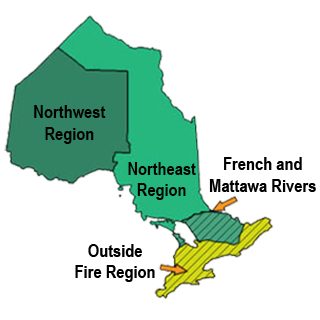
 South of the French and Mattawa rivers call 911.
Interactive fire map
Real time updates.
Our interactive map visually shows active fires, current fire danger across the province and restricted fire zones in effect.
The map now shows perimeters for some fires over 40 hectares in size. Note that not all fires are mapped and perimeters are not updated every day (may differ from the size reported in the table).
Most of the data used in the Interactive Map is available on Ontario GeoHub.
We recommend using Google chrome as your web browser to access the map.
Ontario's fire season starts April 1
Aviation, Forest Fire and Emergency Services reminds the public that outdoor fire rules are in effect throughout Ontario’s legislated fire season, which runs from April 1 to October 31. To dispose of yard waste and woody debris, we encourage the use of alternatives such as composting or utilizing your local landfill. If you must burn, use caution and follow the rules outlined in Ontario’s Wildland Fire Management regulation.
Fires are to be ignited no sooner than 2 hours before sunset and extinguished no later than 2 hours after sunrise. Always ensure you have adequate tools and water available to contain the fire at the site. Know the rules for safe outdoor burning. Read the full set of outdoor fire rules.
Residents within municipal boundaries must also check with their local fire department for burning restrictions or permitting requirements prior to burning.
Wildland Fire Management Act
Effective April 1, several regulatory changes come into effect as a result of updates to the Wildland Fire Management Act. These amendments will help to ensure greater awareness of rules designed to prevent unwanted human-caused fires and include:
- A new Ontario Regulation 44/26 (Administrative Penalties) to establish a framework for issuing administrative monetary penalties for contraventions of the Act or its regulations, generally before a wildland fire has occurred.
- Replacing the Outdoor Fires regulation with the Ontario Regulation 43/26 (Wildland Fire Management) to clarify, streamline, and reduce permit requirements.
- Amendments to the existing cost recovery regulation.
- Updates to short form wordings in an existing regulation.
These amendments will help modernize wildland fire management and protect Ontario communities throughout current and future wildland fire seasons. To learn more about the updates now in effect, keep an eye out for our social media posts this month or visit the Wildland Fire Management Act webpage found on e-Laws.
Learn more about the regulations.
- Ontario Regulation 44/26 (Administrative Penalties)
- Ontario Regulation 43/26 (Wildland Fire Management)
Forest fire updates
Northeast Region
Updated: June 11, 2026 at 6:00 p.m. Eastern Daylight Time (EDT)
Northeast Region
There was one wildland fire confirmed in the Northeast Region today:
- Chapleau 6 (CHA006) was 0.1 of a hectare and located approximately 0.1 of a kilometre east of Highway 17 and 3.2 kilometres south of Highway 552. The fire is out.
At the time of this update, there are 3 active wildland fires in the Northeast Region. Of those fires, 1 is not under control, 1 is being observed, and 1 is under control.
Fire of Note
- Timmins 9 (TIM009) Timmins 9 was first confirmed on Sunday, May 31. Due to more effective remapping of this wildland fire, the size has been updated to 3151 hectares. 15 Ontario FireRanger crews, a 20-person Incident Management Team, 7 pieces of heavy equipment and 5 helicopters are assigned to wildland fire Timmins 9, which is located approximately 10 km from Gogama, 7 km west of Mattagami First Nation and 1.5 km west of Highway 144. The significant amount of rain that has fallen since Tuesday evening in Gogama and surrounding areas has contributed to reducing the fire behavior of Timmins 9. Crews continue to make good progress with ongoing fire suppression operations.
UPDATED - Restrictions in place in the area of Timmins 9
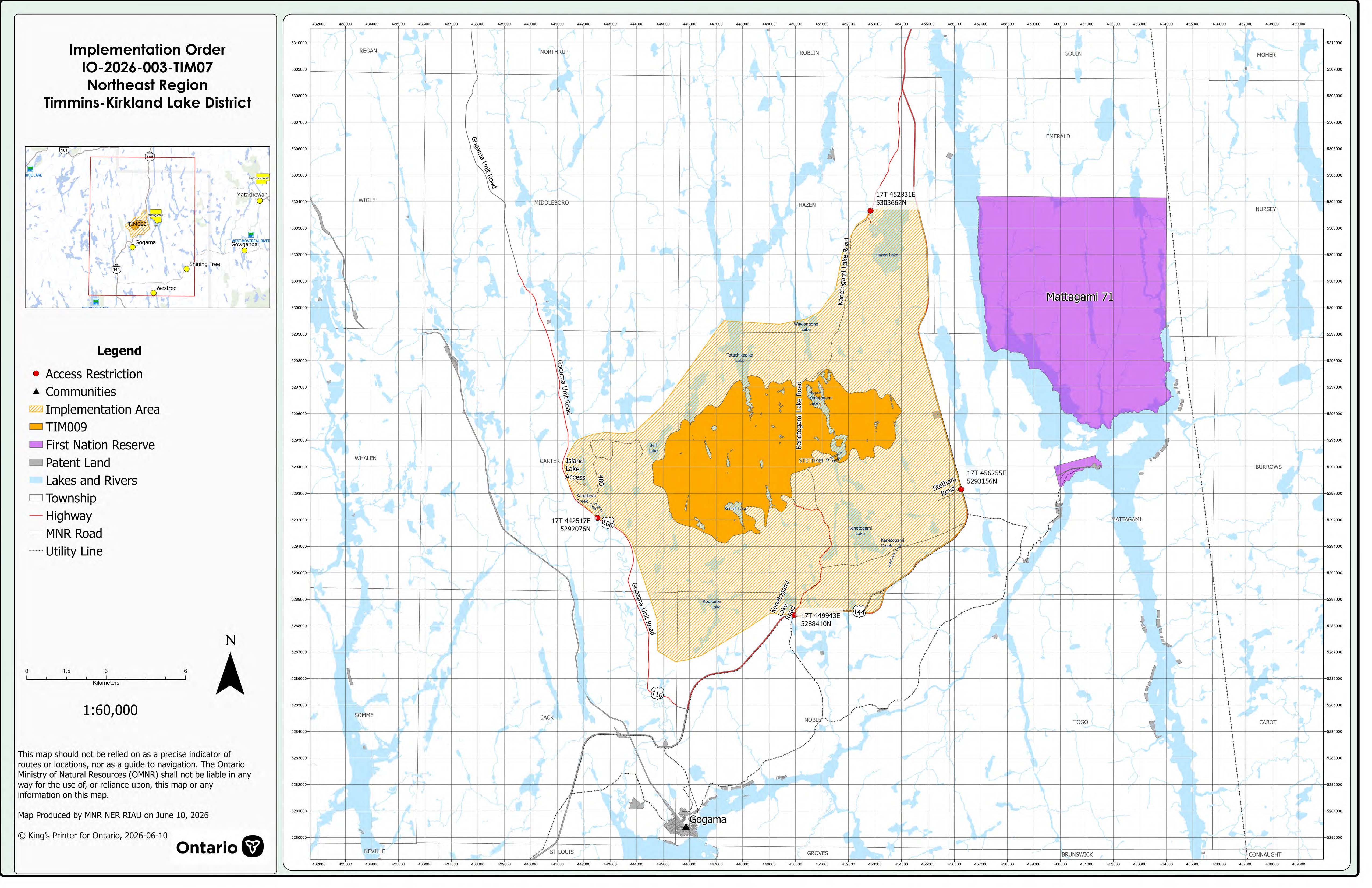
The Ministry of Natural Resources’ Timmins -Kirkland Lake District has invoked an Implementation Order now in effect for the purposes of public safety and fire suppression, for areas near wildland fire Timmins 9, under the Emergency Area Order EAO 2026-003 declared on June 2, 2026.
- All travel and use of Road 480 off Gogama Unit Road (UTM 17T 442517E 5292076N) as outlined in the attached Implementation Order (IO) map within the Emergency Area Order (EAO), is prohibited unless authorized by an Exemption Permit issued by the Timmins – Kirkland Lake District Ministry of Natural Resources (MNR).
- All travel and use of Kenetogami Lake Road from Highway 144 (UTM 17T 449943E 5288410N) north to the Hazen Lake intersection (UTM 17T 452831E 5303662N) as outlined in the IO map within the EAO, is prohibited unless authorized by an Exemption Permit issued by the Timmins – Kirkland Lake District MNR.
- All travel and use of Stetham Road off Highway 144 (UTM 17T 456255E 5293156N) as outlined in the IO map within the EAO, is prohibited unless authorized by a Travel Permit issued by the Timmins – Kirkland Lake District MNR.
Review the Implementation Order map.
This Order is in effect at 12:01 AM Eastern Daylight Time on June 12, 2026 until such time as the order is revoked.
For exemption permit information, please call 705-235-1300.
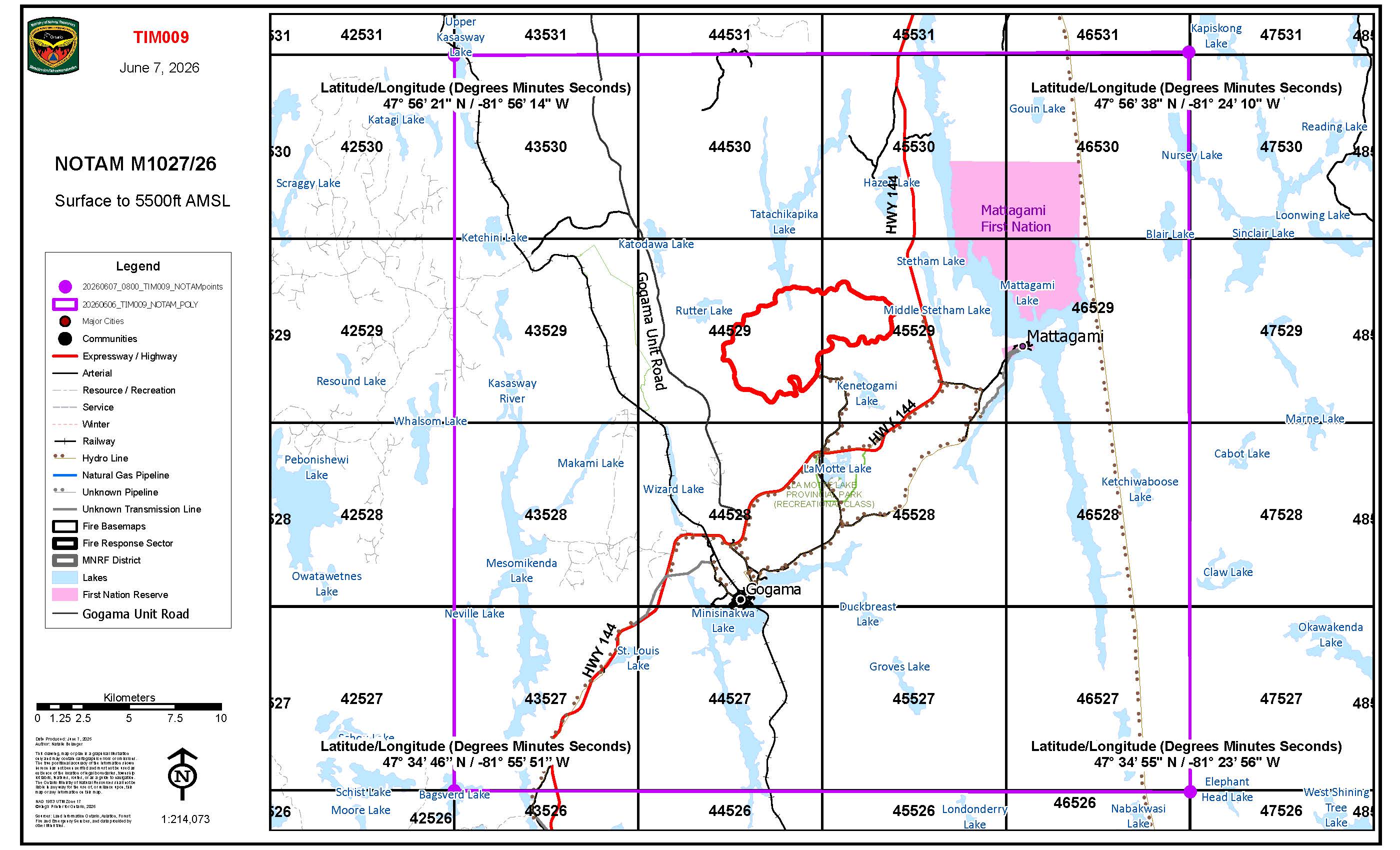
NOTAM in effect - Timmins 9
There is currently a NOTAM in the area of wildland fire Timmins 9.
This is over and above the standard airspace restrictions imposed by Section 601.15 of the Canadian Aviation Regulations (CARs) which state that the airspace around all active forest fires is restricted to forest fire suppression aircraft only, specifically airspace within 5 nautical miles, up to an altitude of 3000 feet above ground level.
Pilots are reminded that NOTAMs concerning forest fires can be found on NavCanada’s Collaborative Flight Planning Services under the ‘Weather and NOTAM’ tab, when flight planning.
Access the NOTAM map.
To access the current forest fire danger rating in your area visit our interactive fire map.
Northwest Region
Updated: June 11, 2026 at 6:15 p.m. Central Daylight Time (CDT)
At the time of this update there are 9 active wildland fires in the Northwest Region. Of those fires, 3 are not under control, 2 are under control and 4 are being observed.
One new fire was confirmed in the Northwest Region by the evening of June 11.
- Thunder Bay 25 (THU025) was located approximately half a kilometre east of the intersection of Highway 102 and Alppila Road. The fire was called out at 0.1 hectares.
To access the current forest fire danger rating in your area visit our interactive fire map.
Fire of Note
Dryden 13 (DRY013)
- Dryden 13 is located in the southern portion of Wabakimi Provincial Park, approximately 41 kilometres west of Armstrong.
- The fire remains at 14,100 hectares and is not under control.
- There are 14 FireRanger crews and 4 helicopters assigned to fire suppression operations.
- Five Type-2 firefighting crews arrived on the fire line today.
- Smoke drift is still being observed under windy conditions.
NOTAM in effect - Dryden 13
There is currently a NOTAM in the area of wildland fire Dryden 13.
This is over and above the standard airspace restrictions imposed by Section 601.15 of the Canadian Aviation Regulations (CARs) which state that the airspace around all active forest fires is restricted to forest fire suppression aircraft only, specifically airspace within 5 nautical miles, up to an altitude of 3000 feet above ground level.
Pilots are reminded that NOTAMs concerning forest fires can be found on NavCanada’s Collaborative Flight Planning Services under the ‘Weather and NOTAM’ tab, when flight planning.
Restricted fire zones
There are currently no restrictions in effect.
If your municipality has also imposed a fire ban, you must comply with both the restricted fire zone (RFZ) and municipal fire ban.
Contact information
Northeast Region
Evan Lizotte
Fire Information Officer
Sydney Morgan-Gervais
Fire Information Officer
Northwest Region
Alison Bezubiak
Fire Information Officer
Victoria Lee
Fire Information Officer
Social media
Check out our Facebook, Instagram and X (formerly Twitter) accounts for safety tips and other wildland fire related information.
For highway conditions, including road closures, call
For air quality in your area, visit:
public weather alerts for Canada
For smoke drift conditions across North America, visit:
smoke drift across North America
For information about wildland fire smoke and your health, consult:
smoke and your health
Fires: year to date
These figures represent the year-to-date total number of wildland fires inside Ontario’s fire region for the 2026 fire season, as they compare to the 2025 season and to the 10-year average.
- 158fires in 2026
- 175fires in 2025
- 14910-year average
Fire bans in provincial parks
For all park fire bans visit:
Ontario parks alerts
You are responsible for fires you light
From April through October, people using outdoor fires must follow strict guidelines under the Wildland Fire Management Act of Ontario to ensure their fires are properly managed.
Anyone who starts a fire outdoors must take all necessary steps to tend the fire, keep it under control and make sure the fire is out before leaving the site. A person failing to burn safely could be fined and held responsible for the cost of putting out the fire. People living in municipalities should check with local fire officials for bylaws on outdoor fires.
Hunters
- Check the interactive fire map to find out where the active wildland fires are in Ontario.
- Be aware of FireRangers who may be working in wildland areas.
- Check your surroundings for FireRanger activity before discharging your firearm to help keep everyone safe.
About Aviation, Forest Fire and Emergency Services (AFFES)
Visit our forest, wildland and outdoor fires page for more information on AFFES and wildland fire management, including: