

Forest fires
Find information about the current danger, activity and fire restrictions of forest fires and grass and brush fires across Ontario.
Restricted Fire Zone in effect
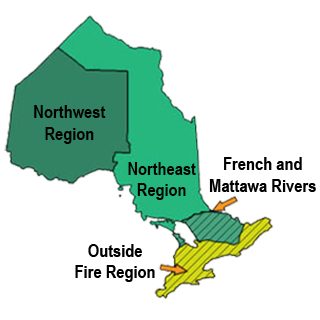
A Restricted Fire Zone (RFZ) is in effect for the Northwest Region and a small portion of the Northeast Region. Learn more about the current RFZ boundaries and restrictions.
Report a fire
 To report a wildland fire (including grass, brush and forest fires) call
 South of the French and Mattawa rivers call 911.
Call or text 2-1-1
Ontarians impacted by wildland fires can call or text 2-1-1 or visit 211ontario.ca to get non-emergency info about available supports and services.
Interactive fire map
Real time updates.
Our interactive map visually shows active fires, current fire danger across the province and restricted fire zones in effect.
The map now shows perimeters for some fires over 40 hectares in size. Note that not all fires are mapped and perimeters are not updated every day (may differ from the size reported in the table).
Most of the data used in the Interactive Map is available on Ontario GeoHub.
We recommend using Google chrome as your web browser to access the map.
Ontario's fire season starts April 1
Aviation, Forest Fire and Emergency Services reminds the public that outdoor fire rules are in effect throughout Ontario’s legislated fire season, which runs from April 1 to October 31. To dispose of yard waste and woody debris, we encourage the use of alternatives such as composting or utilizing your local landfill. If you must burn, use caution and follow the rules outlined in Ontario’s Wildland Fire Management regulation.
Fires are to be ignited no sooner than 2 hours before sunset and extinguished no later than 2 hours after sunrise. Always ensure you have adequate tools and water available to contain the fire at the site. Know the rules for safe outdoor burning. Read the full set of outdoor fire rules.
Residents within municipal boundaries must also check with their local fire department for burning restrictions or permitting requirements prior to burning.
Wildland Fire Management Act
Effective April 1, several regulatory changes come into effect as a result of updates to the Wildland Fire Management Act. These amendments will help to ensure greater awareness of rules designed to prevent unwanted human-caused fires and include:
- A new Ontario Regulation 44/26 (Administrative Penalties) to establish a framework for issuing administrative monetary penalties for contraventions of the Act or its regulations, generally before a wildland fire has occurred.
- Replacing the Outdoor Fires regulation with the Ontario Regulation 43/26 (Wildland Fire Management) to clarify, streamline, and reduce permit requirements.
- Amendments to the existing cost recovery regulation.
- Updates to short form wordings in an existing regulation.
These amendments will help modernize wildland fire management and protect Ontario communities throughout current and future wildland fire seasons. To learn more about the updates now in effect, keep an eye out for our social media posts this month or visit the Wildland Fire Management Act webpage found on e-Laws.
Learn more about the regulations.
- Ontario Regulation 44/26 (Administrative Penalties)
- Ontario Regulation 43/26 (Wildland Fire Management)
Forest fire updates
Northeast Region
Updated: July 30, 2026 at 6:00 p.m. Eastern Daylight Time (EDT)
Five new wildland fires were confirmed in the Northeast Region today:
- Sudbury 39 (SUD039) is 0.1 of a hectare and located approximately 4 kilometres east of Fire Star Lake and 8 kilometres north of Lefebvre Road. The fire is not under control.
- Sudbury 40 (SUD040) is 0.6 of a hectare and located approximately 31 kilometres north of Lake Wanapitei and 4 kilometres east of Bowland Lake. The fire is not under control.
- Sudbury 41 (SUD041) is 0.2 of a hectare and located approximately 18 kilometres south of Swallow Lake and 17 kilometres northeast of Bark Lake. The fire is not under control.
- Sudbury 42 (SUD042) is 0.2 of a hectare and located approximately 4 kilometres north of Mozhabong Lake and 6 kilometres east of Alton Lake. The fire is not under control.
- Sudbury 43 (SUD043) is 0.3 of a hectare and located approximately 29 kilometres north of Lake Wanapitei, and along the northeastern shore of Frederick Lake. The fire is not under control.
One fire was confirmed after last night’s update:
- Sudbury 38 (SUD038) is 0.4 of a hectare and located approximately 2 kilometres west of Camp Seven Lake, and 3 kilometres northeast of Paradise Lake. The fire is not under control.
There are currently 45 active wildland fires in the Northeast Region. Of these fires: 9 are not under control, 2 are being held, 1 is under control and 33 are being observed.
To access the current forest fire danger rating in your area visit our interactive fire map.
Northwest Region
Updated: July 30, 2026 at 7:30 p.m. Central Daylight Time (CDT)
There were 2 new wildland fires confirmed in the Northwest Region by the evening of July 30.
- Red Lake 26 (RED026) is located southwest of Confusion Lake, near Bond Road. The 0.2-hectare fire is being held.
- Kenora 27 (KEN027) is located approximately 3 kilometres west of Highway 525, near Pig Lake. The 2.0-hectare fire is not under control.
At the time of this update there are 115 active wildland fires in the Northwest Region. Of those fires, 22 are not under control, 6 are being held, 5 are under control 82 are being observed.
To access the current forest fire danger rating in your area visit our interactive fire map.
Fires of note
Thunder Bay 36 (THU036) and the Brightsand Cluster - Dryden 34 (DRY034), Dryden 35 (DRY035), Thunder Bay 54 (THU054)
- The incoming Incident Management Team that has assumed command of Thunder Bay 36 wildland fire today (June 30) will also be assuming command of Dryden 34, 35, Thunder Bay 54 tomorrow, July 31.
- THU036 is currently measuring 313,930 hectares and is not under control.
- Crews are extinguishing hot spots with pumps and hose, supported by helicopter bucketing operations. These coordinated efforts are focused on securing the fire perimeter.
- Heavy equipment operators are constructing fire guards to create gaps in forest fuels, helping to limit fire spread and support containment efforts.
- Values protection plans are being developed by an Alberta Wildland Urban Interface (WUI)Team.
- DRY034 is currently measuring 44,954 hectares and remains not under control.
- DRY035 is currently measuring 22,461 hectares and remains not under control.
- THU054 is currently measuring 7,389 hectares and remains not under control.
- Ontario and Alberta crews continue to make good progress under favourable weather conditions, working alongside heavy equipment operators and bucketing helicopters.
Atikokan Cluster - Fort Frances 14 (FOR014), Fort Frances 15 (FOR015), Fort Frances 38 (FOR038)
- FOR014 has been more accurately remapped to a slightly smaller size of 51,768 hectares.
- Increased fire behaviour on northern interior of FOR014 yesterday was reflective of drying conditions. Today’s rainfall reduced fire behaviour again.
- Firefighting crews are working from multiple locations along the fire perimeter, using a pump-and-hoseline system and working towards one another.
- Helicopters continue to support suppression efforts by dropping water on hotspots and moving crews and equipment
- FOR015 is currently measuring 42,273 hectares and remains not under control.
- Crews are busy on the north side of FOR015 where fire behaviour has been more active as fuels dry out in the hot weather. Bucketing support from the helicopters is allowing the crews to make good progress in this area of the fire.
- FireRanger Crews on the west side of FOR015 continue to establish and consolidate hose line, patrol the established hoselines and are working inward to approximately 100 feet from the perimeter.
- FOR038, north of Crystal Lake, remains under control at 44.2 hectares in size.
- One crew is working to extinguish remaining hotspots identified by low-level infrared scanning
Dryden 36 – Upper and Lower Moosehide Lakes
- The fire is now being held at 1,710 hectares.
- This change in status indicates that with currently committed resources, sufficient suppression action has been taken so that the fire is not likely to spread beyond existent or predetermined control boundaries under prevailing or forecasted conditions
- Ontario FireRangers and Type-2 crews are working alongside bucketing helicopters and heavy equipment operators in suppression operations.
- Low fire behaviour has observed in recent days under favourable weather conditions.
Sioux Lookout 72 – Cat Lake First Nation
- The fire is currently measuring 23,597 hectares and is not under control.
- FireRanger crews are making good progress on suppression efforts supported by bucketing helicopters targeting hotspots.
- Hand-held and aerial infrared scanning is being utilized to identify remaining hotspots.
- Minimal fire behaviour was observed today.
Highway 599 Cluster – Sioux Lookout 84 (SLK084), Sioux Lookout 86 (SLK086), Sioux Lookout 89 (SLK089)
- There has been no fire recent growth observed on cluster of fires.
- There are currently 120 personnel assigned to the incident, supported by five helicopters.
- Across all three fires, firefighters are using hand tools, pumps, and hose to extinguish remaining sources of heat.
- Operations were delayed this morning due to an early morning cold front that brought rain and poor visibility.
- Helicopter bucketing operations were not required today due to the rainfall received this morning.
- SLK084 is currently measuring 4,796.6 hectares and remains not under control.
- SLK086 is currently measuring 5,644 hectares and remains not under control.
- SLK089 is currently measuring 7,190.1 hectares and remains not under control.
Evacuation Orders
Evacuation Order - Dryden 36
- All persons must immediately evacuate the area indicated on the attached map unless authorized by an exemption permit issued by the Ministry of Natural Resources.
- All persons are prohibited from entering the area indicated on the attached map unless authorized by a exemption permit issued by the Ministry of Natural Resources.
Review the Evacuation Order Map here.
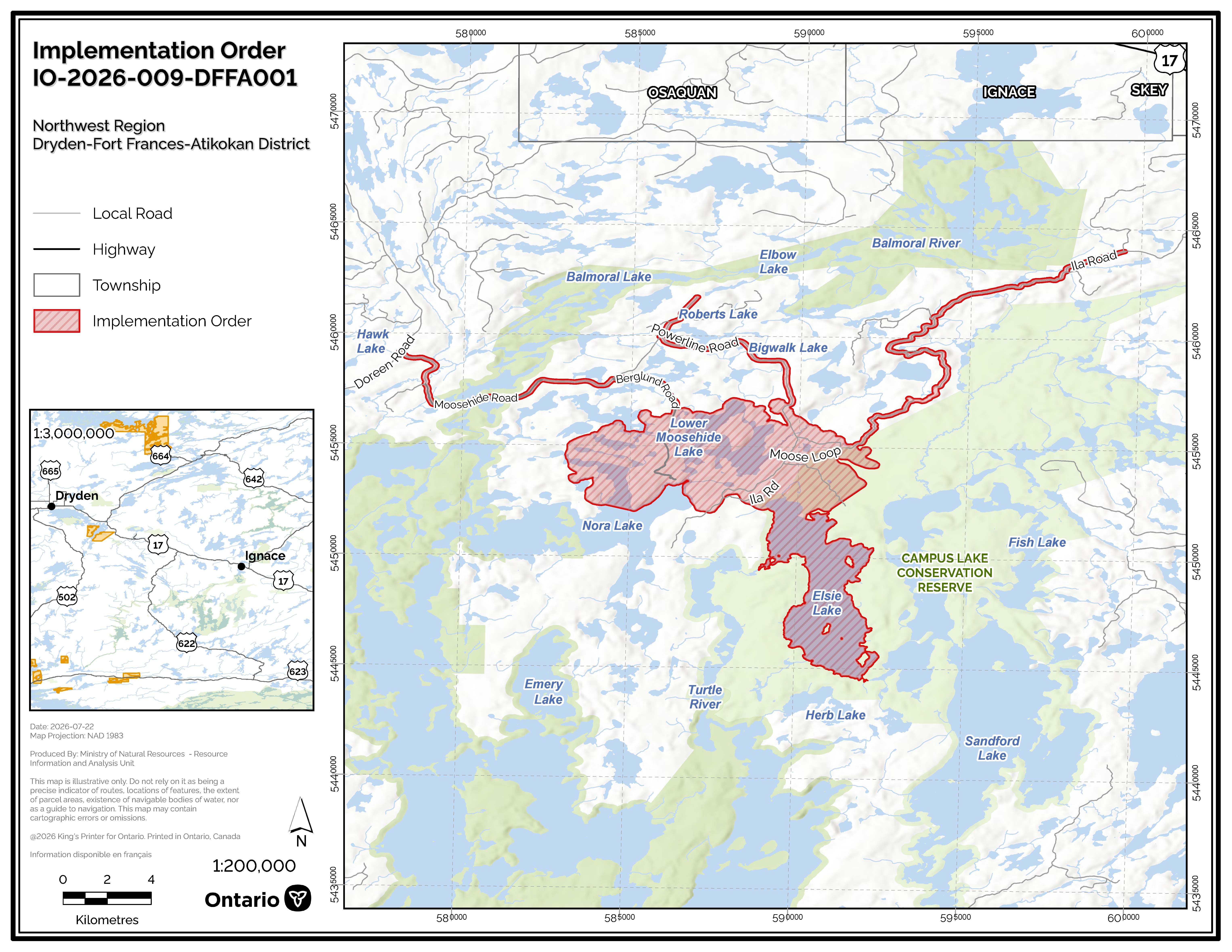
This Order is in effect as of July 22, 2026 at 18:01 Central Daylight Time until such time as the order is revoked.
For exemption permit information, please call
*Due to the high volume of calls, a representative from the MNR Thunder Bay - Ignace District will return your call as soon as possible.
Evacuation Order - Thunder Bay 36, 54 & 56 and Dryden 34 & 35
- All persons must immediately evacuate the area indicated on the attached map unless authorized by an exemption permit issued by the Ministry of Natural Resources.
- All persons are prohibited from entering the area indicated on the attached map unless authorized by a exemption permit issued by the Ministry of Natural Resources.
Review the Evacuation Order Map here.
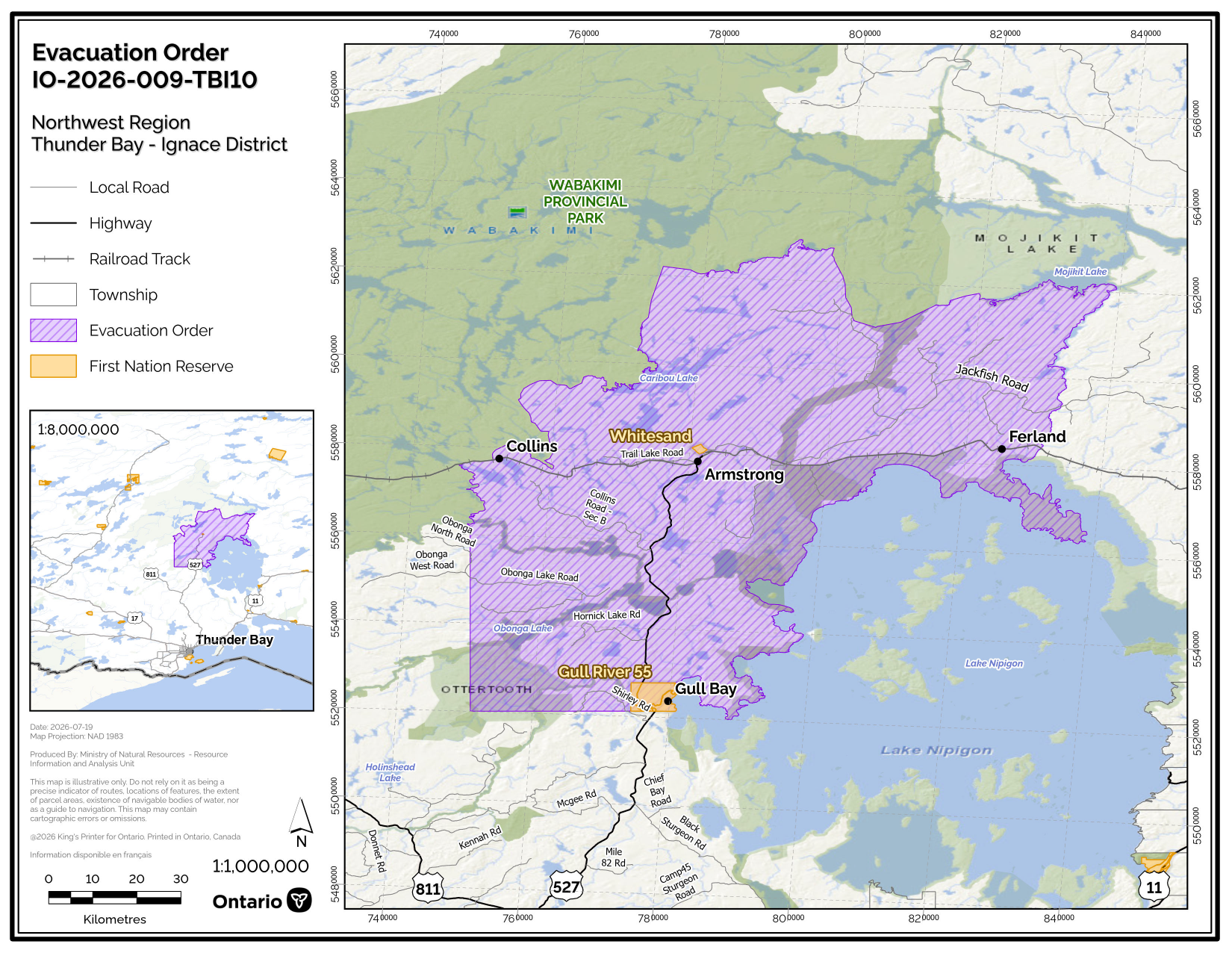
This Order is in effect as of July 20, 2026 at 07:00 a.m. Eastern Daylight Time until such time as the order is revoked.
For exemption permit information, please call
*Due to the high volume of calls, a representative from the MNR Thunder Bay - Ignace District will return your call as soon as possible.
To support evacuees, a reception centre is open at Fort William Gardens Arena, located at 901 Miles St E, Thunder Bay.
The centre includes sleeping accommodations, food, water, hygiene kits, and medical supports.
Evacuation Order - Fort Frances 14
- All persons must immediately evacuate the area indicated on the attached map unless authorized by a travel permit issued by the Ministry of Natural Resources.
- All persons are prohibited from entering the area indicated on the attached map unless authorized by a travel permit issued by the Ministry of Natural Resources.
Review the Evacuation Order Map here.
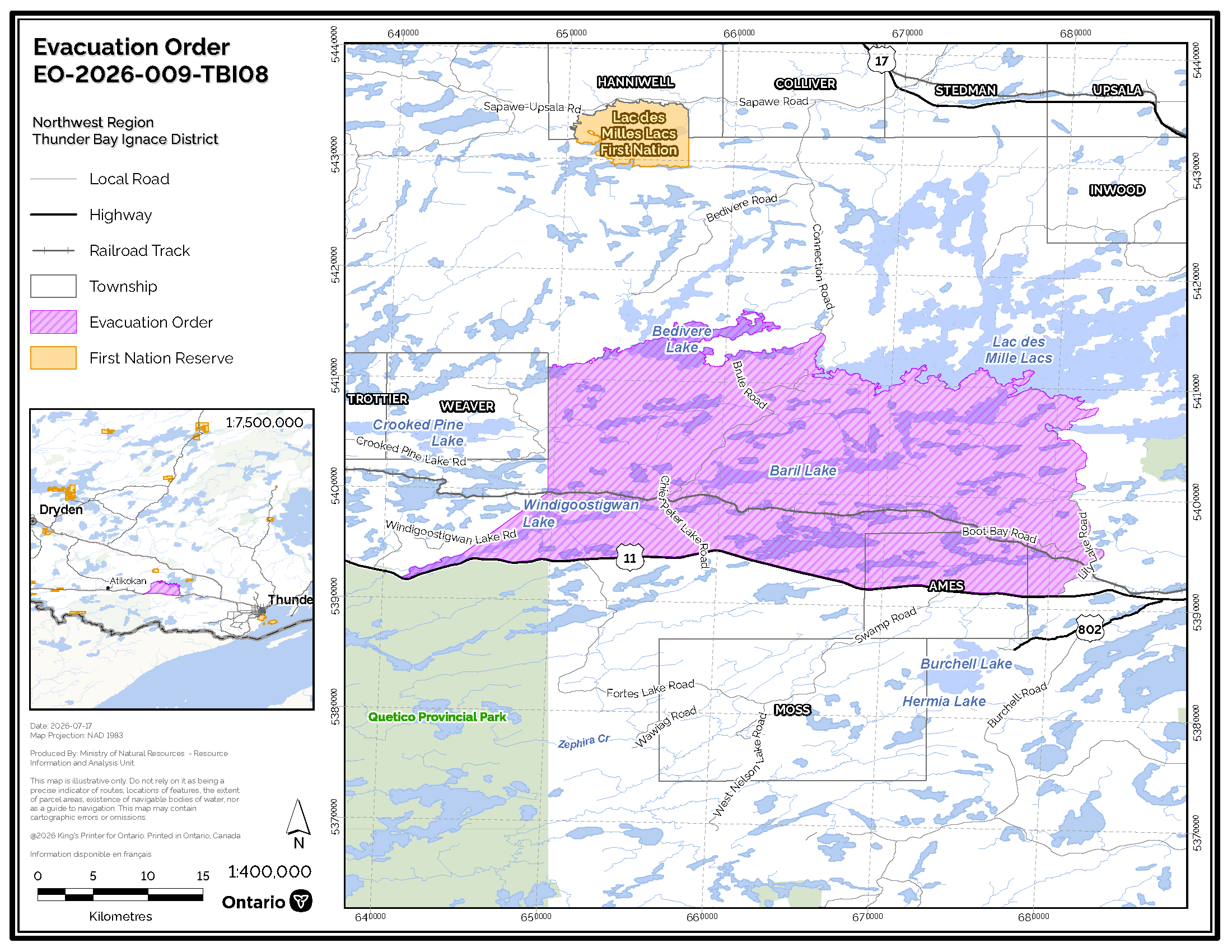
This Order is in effect as of July 17, 2026 at 7:00 a.m. Eastern Daylight Time until such time as the order is revoked.
For exemption permit information, please call
*Due to the high volume of calls, a representative from the MNR Thunder Bay - Ignace District will return your call as soon as possible.
To support evacuees, a reception centre is open at Fort William Gardens Arena, located at 901 Miles St E, Thunder Bay.
The centre includes sleeping accommodations, food, water, hygiene kits, and medical supports
Implementation Orders
Restrictions in effect - Dryden 36
The Ministry of Natural Resources’ Thunder Bay – Ignace District has invoked an Implementation Order now in effect for the purposes of public safety and fire suppression, for areas near Dryden 36, under the Emergency Area Order EAO 2026-009 declared on July 15, 2026.
- All travel and use of Berglund Road, Ila Road, Moosehide Road, Powerline Road as outlined in the identified area on the attached Implementation Order map within the EAO is prohibited unless authorized by a permit to engage in specified activities issued by the Thunder Bay-Ignace District of the Ministry of Natural Resources (MNR).
- All modes of travel/access into Balmoral River, Bigwalk Lake, Elsie Lake, Nora Lake, Roberts Lake, Turtle River and all Crown lands as outlined in the identified area on the attached Implementation Order map within the EAO is prohibited unless authorized by a permit to engage in specified activities issued by the Thunder Bay - Ignace District of the MNR.
Review the Implementation Order Map here.
This Order is in effect as of July 22, 2026 at 18:01 Central Daylight Time until such time as the order is revoked.
For exemption permit information, please call
*Due to the high volume of calls, a representative from the MNR Thunder Bay - Ignace District will return your call as soon as possible.
Restrictions in effect - Thunder Bay 36, 54 & 56 and Dryden 34 & 35
The Ministry of Natural Resources’ Thunder Bay - Ignace District has invoked an Implementation Order for the purposes of public safety and/or effectual fire suppression, for areas near Thunder Bay 36, 54 & 56 and Dryden 34 & 35. Under the Emergency Area Order EAO 2026-009 declared on July 15, 2026.
All travel and use of as outlined in the identified area on the attached Implementation Order map within the EAO is prohibited unless authorized by a permit to engage in specified activities issued by the Thunder Bay-Ignace District of the Ministry of Natural Resources (MNR). These include:
- Armistice Rd
- Banksian Road
- Bert Road
- Black Sturgeon Road
- Block 455
- Block 458
- Block Road 11
- Brightsand Road
- Cedar Rapids Road
- Chappelle Road
- Cheek Road
- Cheeseman Road
- Chief Bay Road
- Dog River Road
- Dolly Road
- Empire Loop Road
- Flash Road
- Geikie Loop Road
- Geikie Road
- Glauca Road
- Graham Road
- Gull Road
- Haas Road
- Harry Road
- Hawkowl Road
- Heaven Road 400 North
- Highway 527
- Highway 811
- Jackfish Road
- Kab Road
- Mack Road
- Mack Station Road
- Main Graham Road
- Mcgee Road
- Mile 82 Road
- Mirror Road
- Moberly Lake Road
- Mug Lake Road
- Net 01 (Whalen)
- Numac Road
- Obonga North Road
- Pakashkan Road
- Poshkokagan Access Point
- Railbed Road
- Rd 175
- Rd 570
- Road 1
- Road 180
- Robin Road
- Rondeau Road
- Sideen Road
- Slingshot Road
- South Alley Road
- Sparrow Road
- Tib Road
- Tower Road
- Weaver Road
- Whiddon Road
- Whistle Road
- Willard Road
All modes of travel/access into and all Crown lands as outlined in the identified area on the attached Implementation Order map within the EAO is prohibited unless authorized by a permit to engage in specified activities issued by the Thunder Bay - Ignace District of the MNR. These include:
- Allely Creek
- Aylsworth Creek
- Bad Medicine Lake
- Brightsand River
- Caribou Lake
- Caribou River
- Collaton Lake
- Dazzle Creek
- Dog River
- Duck Creek
- Fallscamp Creek
- Gnome Lake
- Gull River
- Harmon Lake
- Harry Creek
- Heaven Creek
- Hogarth River
- Kabitotikwia River
- Kashishibog River
- Kenna Creek
- Kopka River
- Lake Nipigon
- Little Jackfish River
- Lookout River
- McConnell Creek
- Mojikit Lake
- Moule Lake
- Pikitigushi River
- Poshkokagan River
- Raymond River
- Ricestalk Creek
- Scallop Lake
- Secord Lake
- Seymour Creek
- Shawanabis Lake
- Slant Creek
- South Summit Lake
- Stork Lake
- Wabikon Creek
- Wabinosh River
- Wapikaimaski Lake
- Whitesand River
- Wolf Creek
- Yoho Creek
- Zigzag Lake
Review the Implementation Order map here
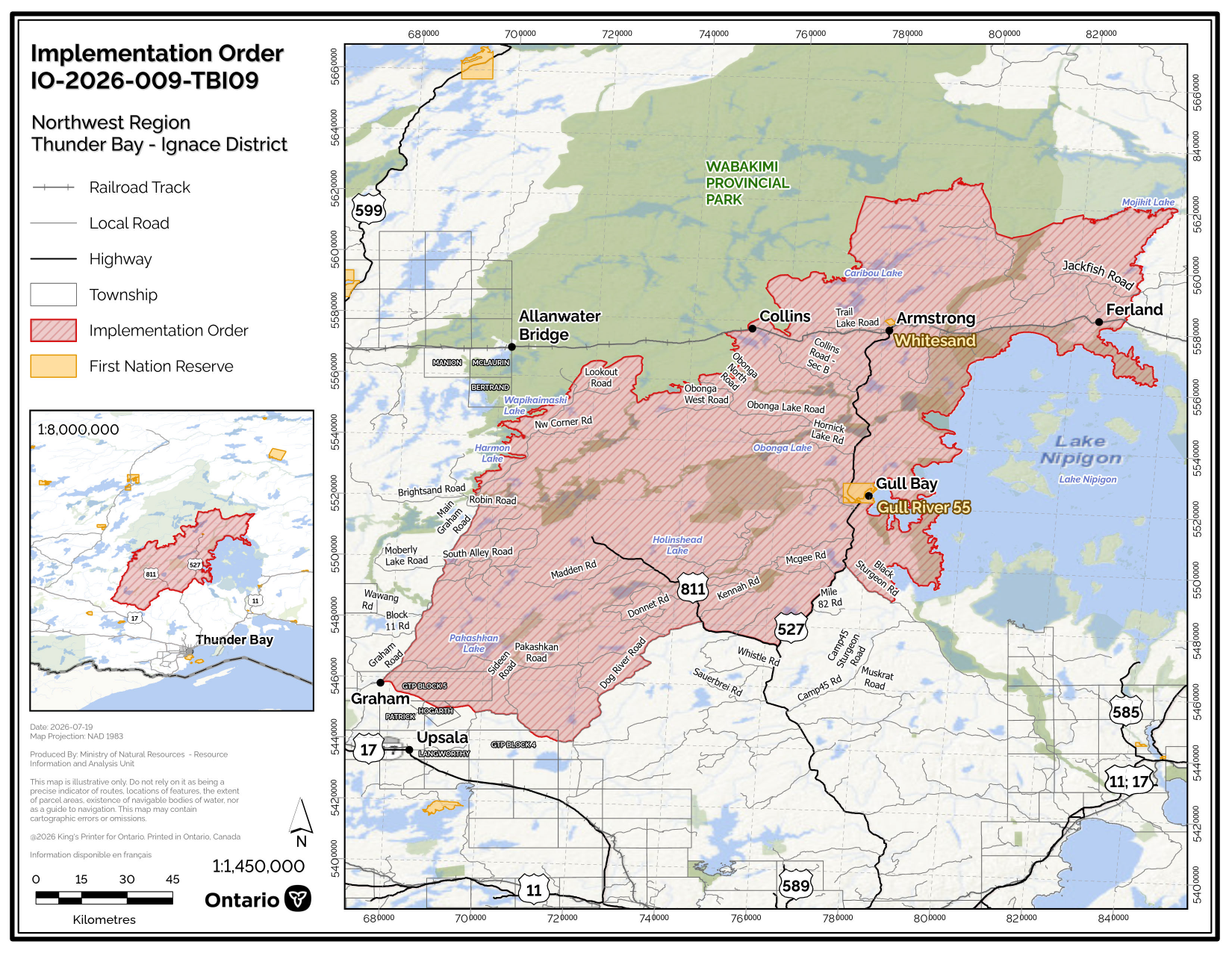
This Order is in effect at 12:01 a.m. Eastern Daylight Time on July 20, 2026 until such time as the order is revoked.
For more information on this Implementation Order, please call
Updated restrictions in effect - Fort Frances 14
The Ministry of Natural Resources’ Thunder Bay – Ignace District has invoked an updated Implementation Order now in effect for the purposes of public safety and fire suppression, for areas near Fort Frances 14, under the Emergency Area Order EAO 2026-009 declared on July 15, 2026. These updated restrictions are in effect at 12:01 a.m. local time on July 25, 2026.
All travel and use of as outlined in the identified area on the below Implementation Order map within the EAO is prohibited unless authorized by a permit to engage in specified activities issued by the Thunder Bay-Ignace District of the Ministry of Natural Resources (MNR). This includes All road-accessible lands and all travel and use of all watercourses situated:
- south of Sapawe Road, commencing at the point where Sapawe Road intersects the western boundary of the Territorial District of Thunder Bay; thence easterly along Sapawe Road to Highway 17, following the western and southern boundaries of Upsala Township; thence easterly along Highway 17 to the eastern boundary of the Little Savanne River; thence southerly along the eastern shoreline of Lac des Mille Lacs (Sawmill Bay) to Round Lake Road; thence southerly along the western edge of Round Lake Road, continuing along the western edge of Athelstane Road, to its intersection with Highway 11; thence westerly along Highway 11 to the southwestern-most point of Windigoostigwan Lake; thence northerly along the western boundary of Windigoostigwan Lake to the western boundary of the Territorial District of Thunder Bay; thence northerly along the western boundary of the Territorial District of Thunder Bay to its intersection with Sapawe Road.
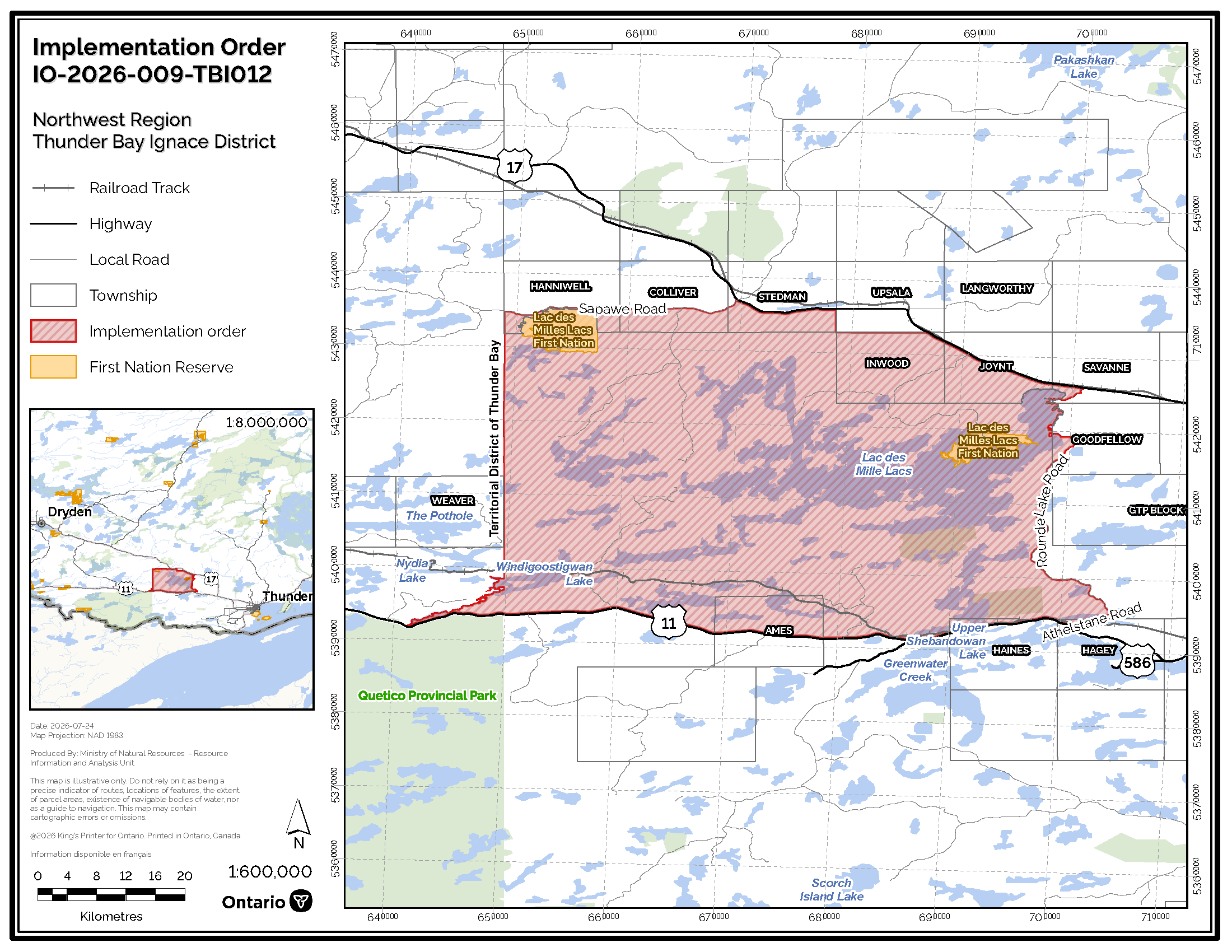
This Order is in effect at 12:01 a.m. Eastern Daylight Time on July 25, 2026 until such time as the order is revoked.
For more information on this Implementation Order, please call
Evacuation Alerts
Evacuation Alert - Fort Frances 13
An evacuation alert has been issued in the Saganaga Lake area by Thunder Bay-Ignace District due to the evolving situation and increased fire behaviour of wildland fire Fort Frances 13 (also known as "Little Knife" fire in Minnesota). People residing in or utilizing the area near the fire, located within Ontario, are strongly encouraged to prepare to evacuate on short notice.
Review the Evacuation Alert Map here.
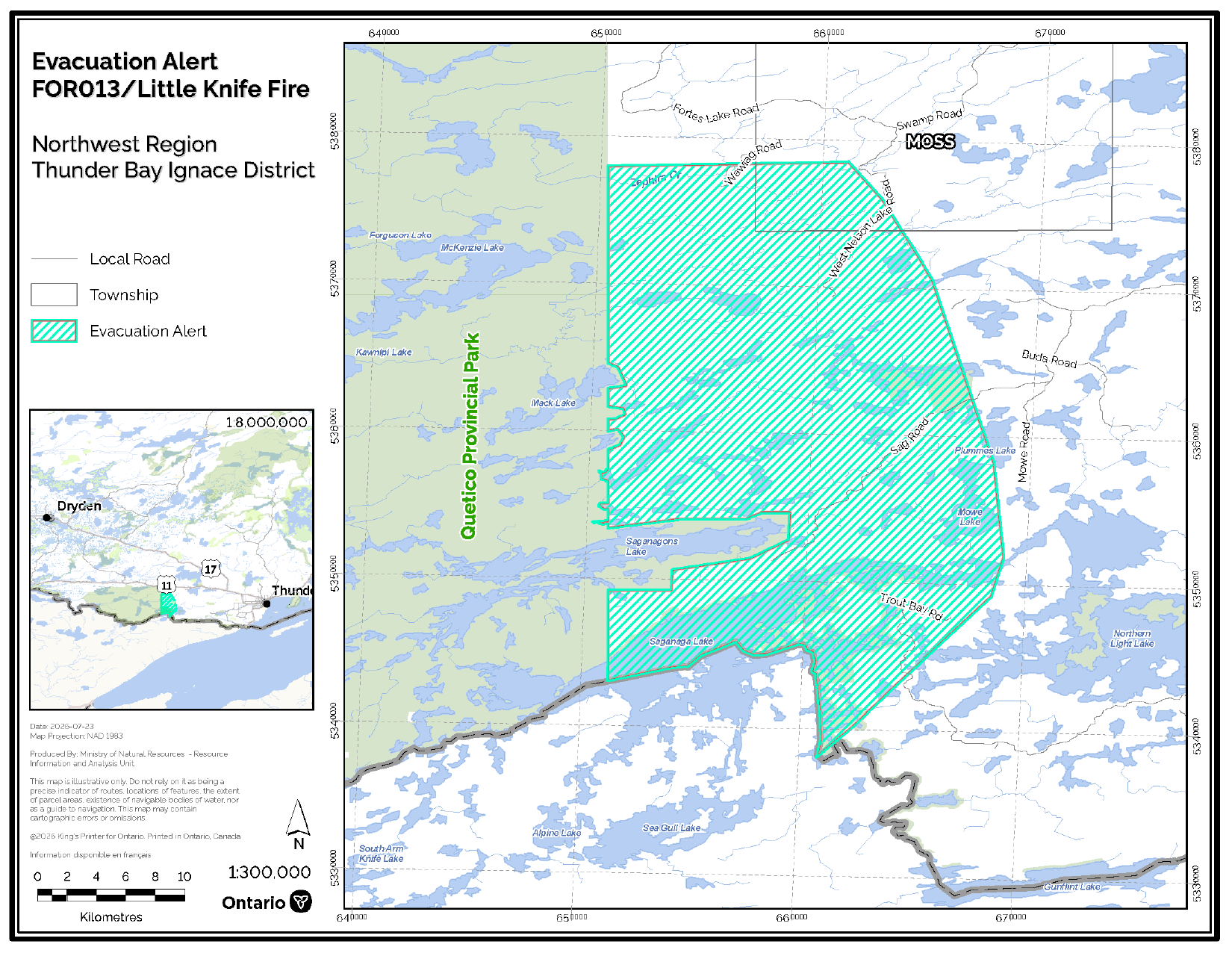
Please plan ahead and stay connected:
- Make sure you are aware of the current fire situation
- Prepare an emergency bag with your essentials (medicine, passports, legal documents etc.)
- Monitor official channels for updates at ontario.ca/fireupdates
- Be ready to quickly leave if instructed
- Respect evacuation orders, road closures and public officials' direction
- Give crews and aircraft ample space to work
This alert is in effect as of July 24, 2026 at 9:00 a.m. Central Daylight Time until such time as the alert is canceled.
For more information on this evacuation alert, please call
Expanded Evacuation Alert - Fort Frances 14
Please be advised that all areas included in the prior Evacuation Order remain under those orders and evacuation is still required.
An expanded Evacuation Alert has been issued for areas within the Thunder Bay-Ignace District near the active wildland fire, Fort Frances 14. This is not an Evacuation Order. Residents in the newly identified alert areas are strongly encouraged to prepare for a possible evacuation and be ready to leave on short notice if conditions change.
This includes the following townships:
- Ames
- Begin
- Blackwell
- Colliver
- Conacher
- Duckworth
- Fallis
- Gibbard
- Goldie
- Goodfellow
- GTP Block 2
- GTP Block 3
- GTR Block 4
- Hagey
- Haines
- Horne
- Inwood
- Joynt
- Lamport
- Langworthy
- Laurie
- Michener
- Moss
- Robson
- Savanne
- Soper
- Stedman
- Upsala
- Wardrope
And all areas accessed by:
- Athelstane Road
- Bedivere Road
- Boot Bay Road
- Brule Road
- Burchell Road
- Chief Peter Lake Road
- Connection Road
- Direct Road
- Dog River Road
- Drift Lake Road
- Fortes Lake Road
- Gold Creek Road
- Graham Road
- Haner Road
- Heart Lake Road
- Hoof Lake Road
- Lac Des Mille Lac Road
- Lily Lake Road
- Mine Road
- NeZaadiikaang Rd
- Numac Road
- Rounde Lake Road
- Sapawe Road
- Seine River Road
- Shabaqua Road
- Shelby Lake Road
- Sideen Rd
- Sideen Road
- Swamp Road
- Township Road
- Wawiag North Road
- Wawiag Road
- West Nelson Lake Road
All areas located on the following lakes:
- Shebandowan Lakes
- Kashabowie Lake
- Burchell Lake
- Lac Des Milles Lacs
- Rudge Lake
- Brule Lake
- Baril Lake
- Lang lake
- Huronian Lake
- Peterkin Lake
- Athelstane
- Little Athelstane Lake
- Bundy Lake
- Worthy Lake
- Milton Lake
- Moss Lake
- Rainbow Lake
Please plan ahead and stay connected:
- Make sure you are aware of the current fire situation
- Prepare an emergency bag with your essentials (medicine, passports, legal documents etc.)
- Monitor official channels for updates at ontario.ca/fireupdates
- Be ready to quickly leave if instructed
- Respect evacuation orders, road closures and public officials' direction
- Give crews and aircraft ample space to work
For more information on this evacuation alert, please call
Evacuation Alert - Fort Frances 15 & 38
An evacuation alert has been issued by Dryden Fort Frances Atikokan District due to the evolving situation and increased fire behaviour of multiple wildland fires including Fort Frances 14, Fort Frances 15 and Fort Frances 38. People residing or utilizing the area near the fires are strongly encouraged to prepare to evacuate on short notice.
This includes the following townships:
- Hutchison
- Ramsay Wright
- Trottier
- Weaver
All areas accessed by:
- Boot Lake Road
- Camp 111 Road
- Crooked Pine Lake Road
- Duck Lake Road
- Marion Lake Road
- Premier Lake Road
- Sapawe-Upsala Road
- Stanton Bay Road
- White Lily Road
All areas located on the following lakes:
- Como Lake
- Crystal Lake
- Eva Lake
- Magnetic Lake
- Marion Lake
- Mercutio Lake
- Niobe Lake
- Nydia Lake
- Sapawe Lake
- Whiskeyjack Lake
- Windigoostigwan Lake
Please plan ahead and stay connected:
- Make sure you are aware of the current fire situation
- Prepare an emergency bag with your essentials (medicine, passports, legal documents etc.)
- Monitor official channels for updates at ontario.ca/fireupdates
- Be ready to quickly leave if instructed
- Respect evacuation orders, road closures and public officials' direction
- Give crews and aircraft ample space to work
For more information on this evacuation alert, please call
Evacuation Alert - Fort Frances 39 & Minnesota’s ‘Thumb Fire’
An evacuation alert has been issued by Dryden Fort Frances Atikokan District due to the evolving situation and increased fire behaviour of wildland Fire Fort Frances 39 and Minnesota’s ‘Thumb Fire’. People residing or utilizing the area near the fires, located within Ontario, are strongly encouraged to prepare to evacuate on short notice.
This includes all areas accessed by:
- Lagoon Road
And all areas located on the following lakes:
- Blue Lake
- Cranberry Lake
- Lac La Croix
- Lilac Lake
- Loon Lake
- Queer Rock Lake
- Spring Lake
- Thompson Lake
- Trout Lake
Please plan ahead and stay connected:
- Make sure you are aware of the current fire situation
- Prepare an emergency bag with your essentials (medicine, passports, legal documents etc.)
- Monitor official channels for updates at ontario.ca/fireupdates
- Be ready to quickly leave if instructed
- Respect evacuation orders, road closures and public officials' direction
- Give crews and aircraft ample space to work
For more information on this evacuation alert, please call
NOTAM - Thunder Bay 36
There is currently a NOTAM in the area of wildland fire Thunder Bay 36.
This is over and above the standard airspace restrictions imposed by Section 601.15 of the Canadian Aviation Regulations (CARs) which state that the airspace around all active forest fires is restricted to forest fire suppression aircraft only, specifically airspace within 5 nautical miles, up to an altitude of 3000 feet above ground level.
Pilots are reminded that NOTAMs concerning forest fires can be found on NavCanada’s Collaborative Flight Planning Services under the ‘Weather and NOTAM’ tab, when flight planning.
NOTAM - Fort Frances 14
There is currently a NOTAM in the area of wildland fire Fort Frances 14, northeast of Byers Lake.
This is over and above the standard airspace restrictions imposed by Section 601.15 of the Canadian Aviation Regulations (CARs) which state that the airspace around all active forest fires is restricted to forest fire suppression aircraft only, specifically airspace within 5 nautical miles, up to an altitude of 3000 feet above ground level.
Pilots are reminded that NOTAMs concerning forest fires can be found on NavCanada’s Collaborative Flight Planning Services under the ‘Weather and NOTAM’ tab, when flight planning.
Restricted fire zones
Northwest Region Restricted Fire Zone
Due to the high to extreme fire hazard, increased wildland fire activity, the current fire load and to reduce the number of human-caused wildland fires, the Ministry of Natural Resources will be implementing a Restricted Fire Zone (RFZ) effective July 15 at 12:01 a.m. local time for the Northwest Region and a small portion of the Northeast Region.
The areas impacted are from the corner of the borders of the USA, Manitoba and Ontario, north along the Manitoba and Ontario border to a point southwest of the Echoing River, then southeast in a straight line to roughly 40 kilometres northeast of the community of Kitchenuhmaykoosib, then east to a point roughly 73 kilometres northwest of the community of Attawapiskat, then south to roughly 12 kilometres south of Highway 11, then west to the northeast tip of Sandlink Lakes, then south following Sandlink Creek to Northeast Bay on McKay Lake, following the eastern shore of McKay Lake to the entrance of the Pic River, then south along the Pic River to Lake Superior Canada/US border in Lake Superior. This order is required to reduce the number of human-caused wildland fires. We are expecting the current fire hazard to remain, along with the potential for problematic fires to continue and expect a continuation of the increased forest fire activity into the foreseeable future.
No open air burning, including campfires, is permitted within the boundaries of a RFZ. Portable gas or propane stoves may be used for cooking and warmth but must be handled with extreme caution. All burning permits are suspended. The RFZ will be in place until further notice.
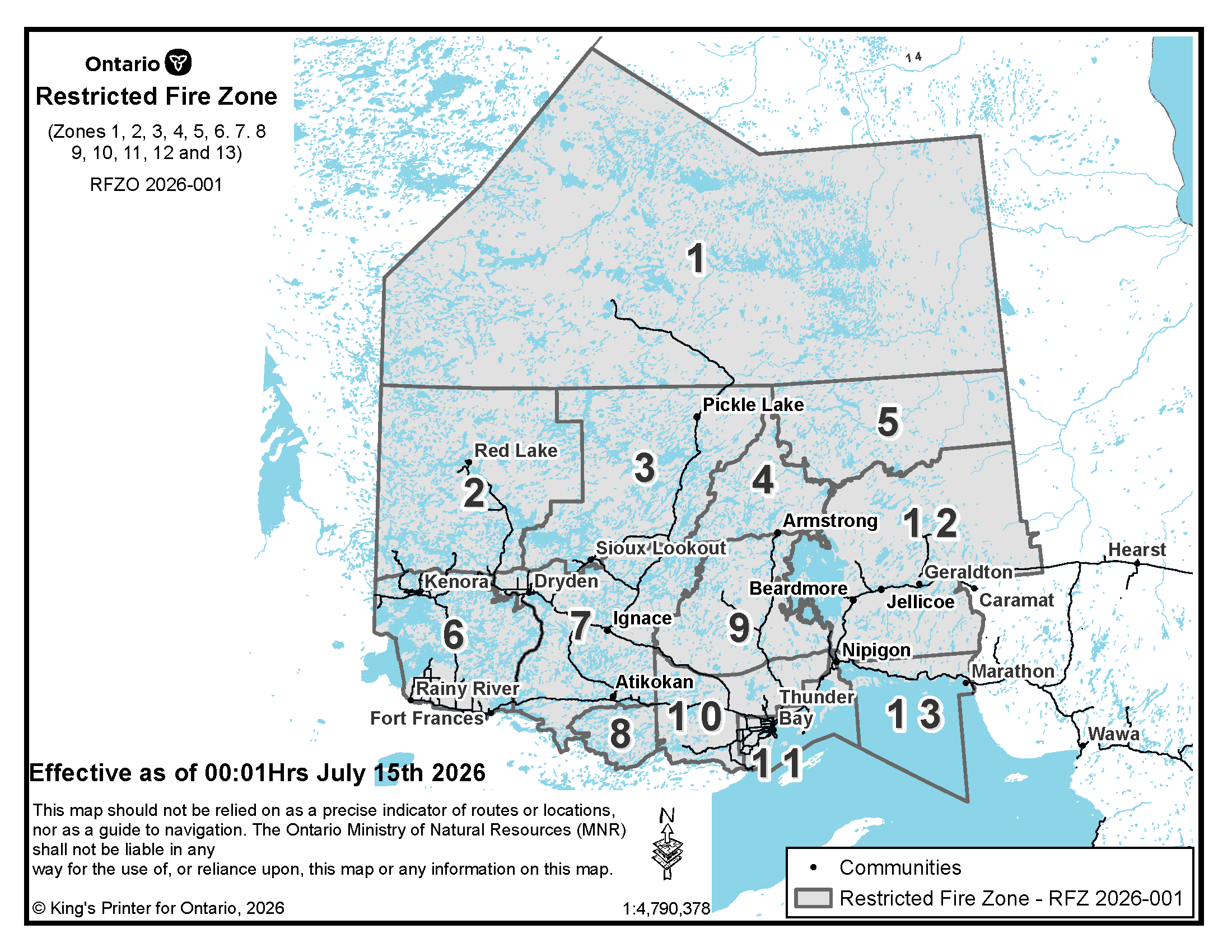
If your municipality has also imposed a fire ban, you must comply with both the restricted fire zone (RFZ) and municipal fire ban.
Revoked Northeast Region Restricted Fire Zone (RFZ)
Due to the widespread precipitation and the associated reduction in the wildfire hazard within Restricted Fire Zones 16, 17 and the small portion of Zone 20 is no longer required, and has been revoked effective Saturday, July 25 at 12:01 a.m. Eastern Daylight Time.
The Restricted Fire Zone (RFZ) in the Northwest region and a small portion of Northeast remains in effect for zones 1, 2, 3, 4, 5, 6, 7, 8, 9, 10, 11, 12, and 13.
The Ministry of Natural Resources would like to thank Ontarians and visitors for doing their part to help prevent wildland fires and keep communities safe. Please continue to use extreme caution and follow Ontario’s Outdoor Fires Regulations when having an outdoor fire.
The province will continue to assess wildland fire hazard conditions, and an RFZ designation may be reinstated in higher risk areas if the fire hazard and fire activity warrants it.
Contact information
Call or text 2-1-1
Ontarians impacted by wildland fires can call or text 2-1-1 or visit 211ontario.ca to get non-emergency info about available supports and services.
Northeast Region
Monitored 8:00 a.m. to 6:30 p.m. Eastern Daylight Time (EDT)
Sydney Morgan-Gervais
Fire Information Officer
Northwest Region
Monitored 8:00 a.m. to 6:30 p.m. Central Daylight Time (CDT)
Victoria Lee and David Copplestone
Fire Information Officers
Atikokan Cluster (FOR014, FOR015, FOR038)
Chris Marchand
Fire Information Officer
Horan Incident Management Team
For exemption permit information, please call
Thunder Bay 36
Isabelle Chenard
Fire Information Officer
Yanni Incident Management Team
For exemption permit information, please call
Social media
Check out our Facebook, Instagram and X (formerly Twitter) accounts for safety tips and other wildland fire related information.
For highway conditions, including road closures, call
For air quality in your area, visit:
public weather alerts for Canada
For smoke drift conditions across North America, visit:
smoke drift across North America
For information about wildland fire smoke and your health, consult:
smoke and your health
Fires: year to date
These figures represent the year-to-date total number of wildland fires inside Ontario’s fire region for the 2026 fire season, as they compare to the 2025 season and to the 10-year average.
- 630fires in 2026
- 389fires in 2025
- 42910-year average
Fire bans in provincial parks
For all park fire bans visit:
Ontario parks alerts

You are responsible for fires you light
From April through October, people using outdoor fires must follow strict guidelines under the Wildland Fire Management Act of Ontario to ensure their fires are properly managed.
Anyone who starts a fire outdoors must take all necessary steps to tend the fire, keep it under control and make sure the fire is out before leaving the site. A person failing to burn safely could be fined and held responsible for the cost of putting out the fire. People living in municipalities should check with local fire officials for bylaws on outdoor fires.
Hunters
- Check the interactive fire map to find out where the active wildland fires are in Ontario.
- Be aware of FireRangers who may be working in wildland areas.
- Check your surroundings for FireRanger activity before discharging your firearm to help keep everyone safe.
About Aviation, Forest Fire and Emergency Services (AFFES)
Visit our forest, wildland and outdoor fires page for more information on AFFES and wildland fire management, including: